

A question that keeps coming up when supporting new parents is whether a baby’s feet should be tucked inside or hanging free of a stretchy wrap.
If your baby is very new and really scrunched up, it can be very tempting to have their feet inside the crossed parts of the wrap. In fact, some older stretchy wrap instructions do show this position, and therefore it can be very confusing when advised to have baby’s legs (or feet if they are really tiny!) out.
I always teach legs out when using a stretchy for several different reasons.
Time
Firstly the window of time when your baby is really scrunched up and it is not easy to separate legs is really really small – days, if at all. This may be slightly different if your baby is premature, but even so, the time frame is very short. A stretchy wrap is a fantastic carrying option for the first 26 weeks or so of your baby’s life – I’d rather take the time to teach you the position you’ll need for the other 25 1/2 weeks that you use the stretchy!
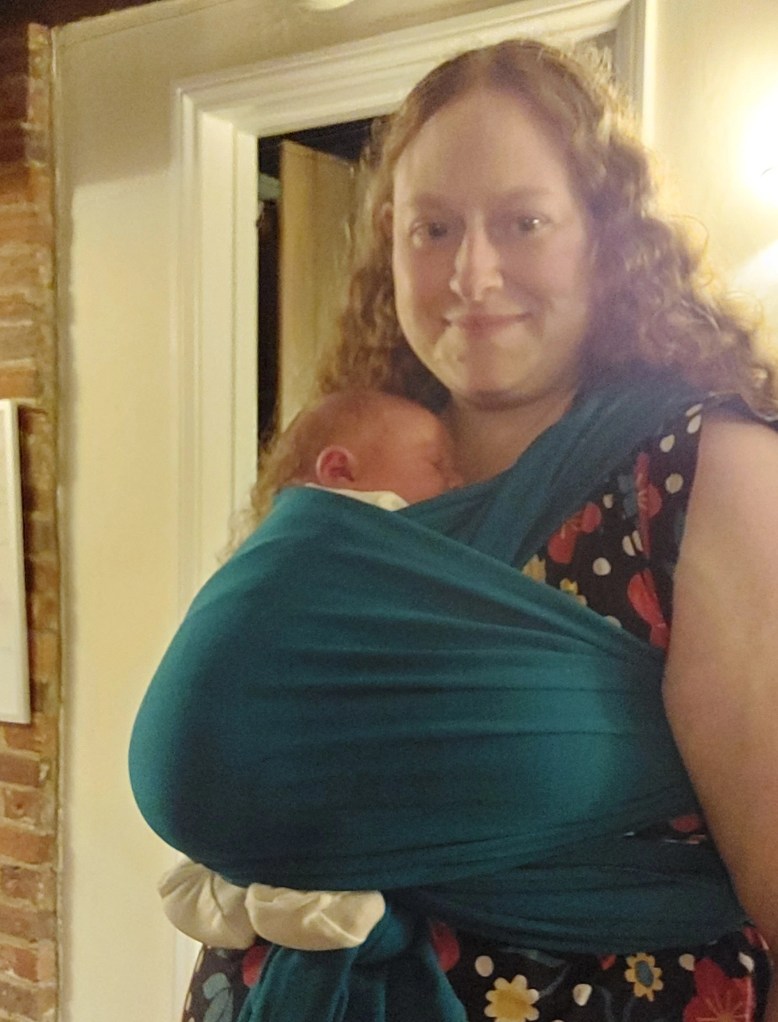
2 day old baby being carried in a stretchy wrap with feet visible, despite being very curled.
Alternative positions
If your baby is very curled, you can use a double hammock position with the stretchy. This prevents hips being over spread as there is no fabric between the legs, your baby is still nicely supported by the carrier, feet are out so you can see the hips are symmetrical, with no weight being held on the feet. Which brings me nicely to reason 3.
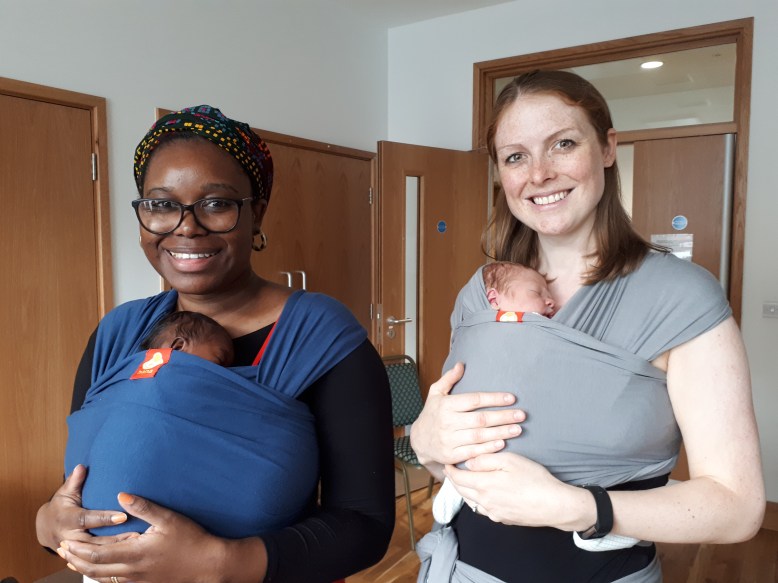
Two new mums expertly modelling their newborn babies in their stretchy wraps with legs out.
Weight on feet
When a baby’s legs are tucked under them, the majority of their weight will be on their lower legs, ankles (if crossed), and feet. Although this is not a safety concern, it is not particularly comfortable for them, and given that you can’t see their feet and lower legs clearly within the fabric, it is very easy to have uneven weight distribution. If you find your baby is upset with the legs tucked in position, it might be that they have pins and needles!
Wonky positioning
When your baby is supported knee to knee with legs out, the fabric is anchoring your baby’s body in the upright position and maintaining the ‘M’ position for your baby’s hips. With their legs tucked in, that stability is lost and they can easily slide to one side. It is harder to see whether the feet are symmetrical, if one hip is higher than the other and whether there is a sideways curve in the spine. It feel like you need to keep a hand on your baby as they are wonky in the sling!

This image shows the crossed fabric between baby’s legs, supporting the knees in the ‘M’ position, before the fabric is spread across the body.
Reflexes
When your baby had their newborn check, you may have seen the doctor or midwife making your baby “walk” along the surface. This stepping reflex lasts around 2 months, and if you put weight or pressure on your baby’s feet in the sling, you may trigger this and find you baby straightens their legs. This can make safe positioning even more difficult as your baby is bouncing around and may appear to dislike being in the wrap.
Positioning your baby’s feet outside the wrap, helps keep your baby in a safe, comfortable position and allows you to easily assess where and how their body is being supported. For in person positioning support, please contact us for a fitting or consultation.
 East Surrey Slings